Chinese Audiences Are Reading Western AI Safety Discourse
Western AI safety treatises are surprisingly well-received in Chinese tech media. What does this mean for international AI policy?
May 18, 2026


In January, Anthropic CEO Dario Amodei published “The Adolescence of Technology,” an essay somberly assessing the risks posed by advanced AI. The day after, an influential WeChat account, AI Era, shared a breathless summary for its mainland Chinese audience: “Amodei warns that with AGI approaching, humanity is about to gain powers beyond imagination. But this power is also a sword of Damocles hanging over the heads of men...” AI Era’s summary was faithful, earnest, and engaged with Amodei’s essay on its own terms. It also describes Amodei as “gentle and elegant”—remarkably sympathetic treatment of one of the most vocal advocates of US chip export controls against China, and of an essay that describes the Chinese Communist Party (CCP) as an existential threat with a clear path to an “AI-enabled totalitarian nightmare.”
The pattern repeated in April, after US Senator Bernie Sanders hosted a panel on AI existential risk featuring leading Chinese academics Xue Lan and Yi Zeng. The event was picked up in a high-profile Chinese commentary syndicated across multiple sites, stressing Sanders’s concerns about existential risk and proposals for an international treaty similar to Cold War nuclear deals.
Amodei’s and Sanders’s treatment in the Chinese media landscape is not unique. As part of a seasonal fellowship with the Centre for the Governance of AI, I collected and analyzed over 60 mainland Chinese media sources discussing four recent Western essays that are relevant to the safety of advanced AI systems. I observed a pattern of urgent and credible Chinese summaries of Western AI safety work, though the coverage often avoided sensitive topics such as US-China competition or CCP control. Western AI safety authors have more impact on Chinese AI safety discussions than they may think.
The four essays for which I analyzed Chinese coverage of were “Situational Awareness,” by Leopold Aschenbrenner; “Superintelligence Strategy,” by Dan Hendrycks, Eric Schmidt, and Alexandr Wang; “AI 2027,” by Daniel Kokotajlo et al.; and the aforementioned “Adolescence of Technology,” by Dario Amodei.
All four pieces predict the emergence of superintelligent AI within the next few years. “Situational Awareness” argues for sustaining US dominance through an AI Manhattan Project. “Superintelligence Strategy” argues that states may mutually deter each other from developing superintelligence. “AI 2027” outlines a US-China race to superintelligence. “The Adolescence of Technology” outlines the key risks from “powerful AI” and how to defend against them.
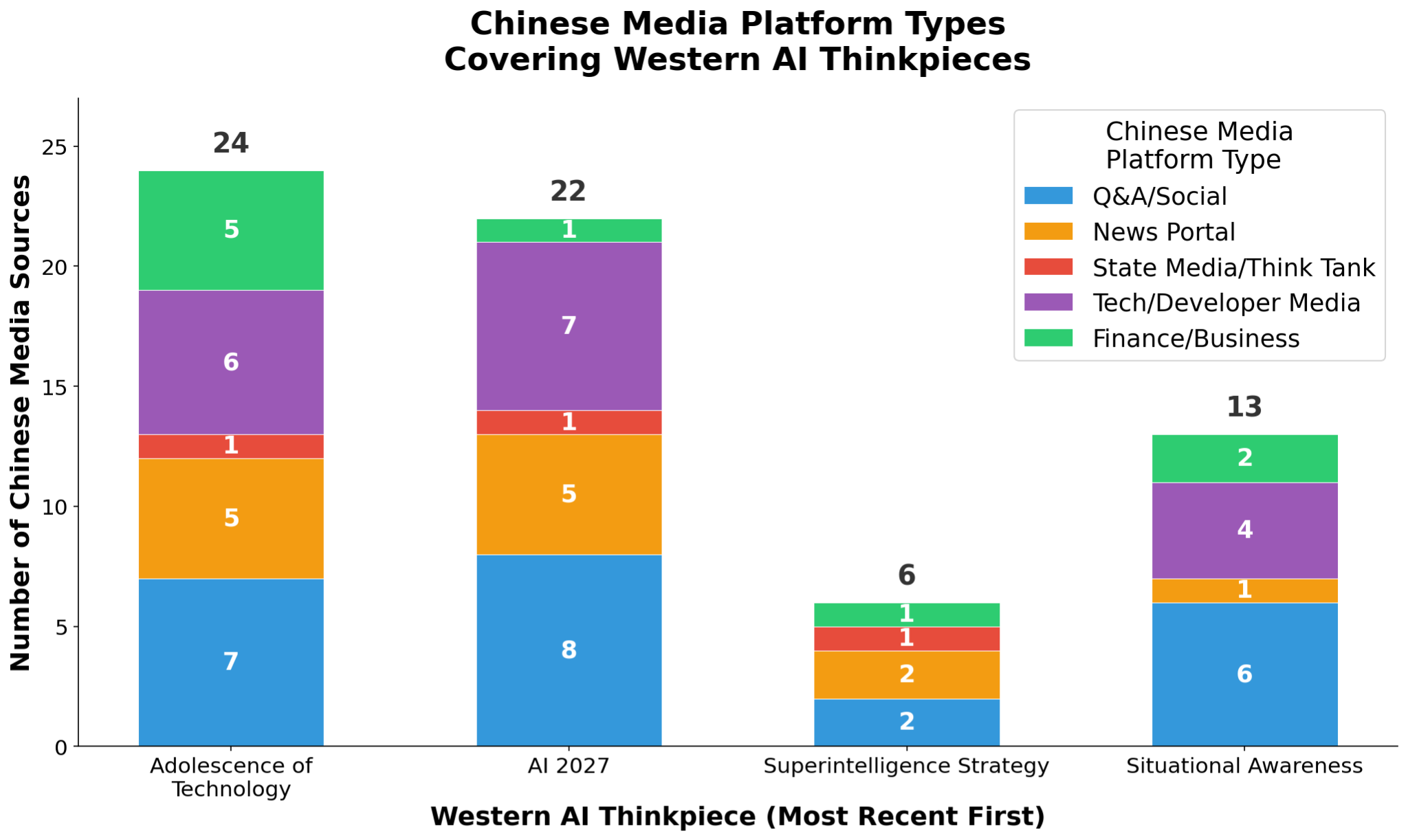
Chinese coverage of the essays varied substantially. “Superintelligence Strategy” had the smallest footprint, with only six Chinese articles. “Situational Awareness” had 13 in total, including a second wave of coverage roughly a year after publication, driven by Aschenbrenner’s hedge fund returns. “AI 2027” and “The Adolescence of Technology” received the most, with over 20 articles each. The uptick over time suggests transformative AI is becoming more salient in China, perhaps partly driven by the “DeepSeek moment,” in early 2025.
/inline-pitch-cta
Most sources received between 1,000 and 100,000 views, with only six exceeding 100,000. Total readership was likely over 1 million for “The Adolescence of Technology” and “AI 2027,” and in the hundreds of thousands for “Situational Awareness” and “Superintelligence Strategy.”
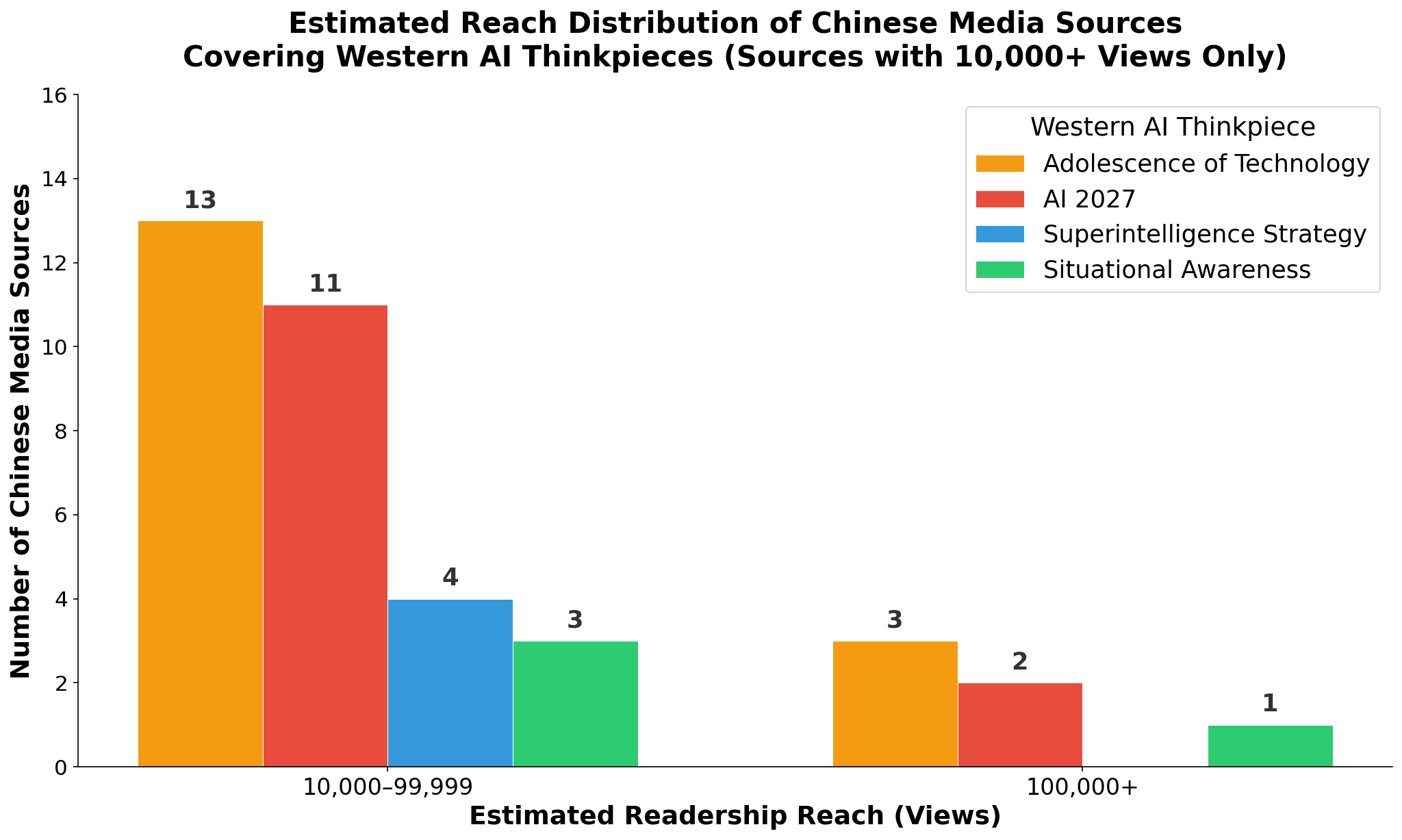
All four essays appear to be freely accessible in mainland China. “AI 2027” and “The Adolescence of Technology” were picked up by The Paper (澎湃新闻), a state media outlet. “Superintelligence Strategy” was discussed by a state-backed think tank. That was the extent of state-affiliated pickup. Major Chinese tech and financial outlets—Sina Finance, Xueqiu, 21st Century Business Herald, Wall Street News (华尔街见闻)—provided extensive coverage of all four.
The highest-quality sources were AI-focused WeChat accounts, particularly AI Era (新智元) and Synced (机器之心), each with millions of followers and regular syndication on mainstream sites. The highest-engagement discussions were on Zhihu (知乎), a leading Chinese Q&A website: threads discussing “AI 2027” reached nearly 200,000 views, while those discussing “The Adolescence of Technology” reached nearly 280,000.
The overwhelming pattern is one of serious, sympathetic engagement. Of the 61 primary sources, 85% adopted a neutral framing (i.e., they did not take a position on their content). One Zhihu user wrote a striking analogy: “We are now seconds before this car goes out of control. The people in the back of the car are still discussing where to eat later, completely unaware that the front of the car has already broken off the cliff.”
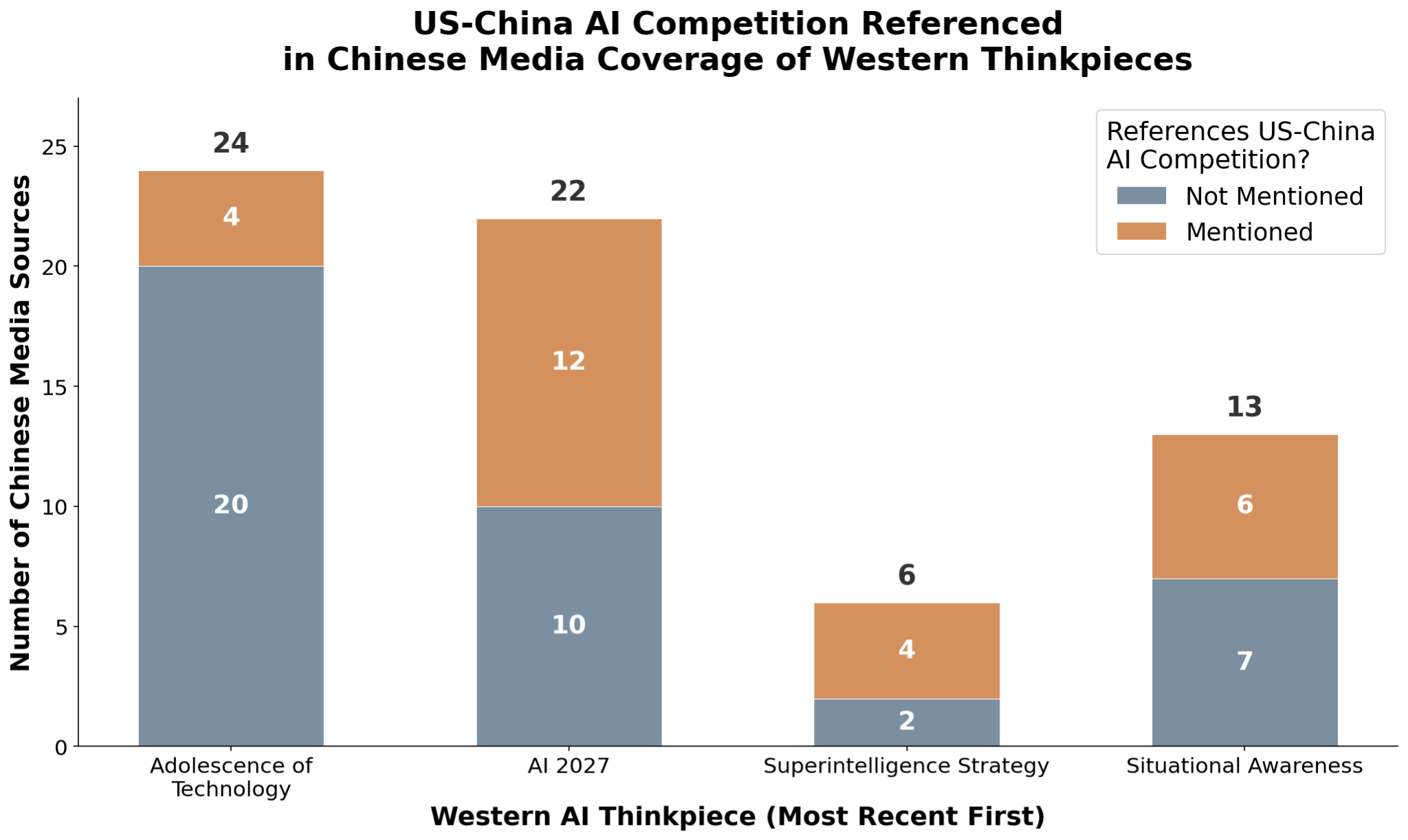
In the Chinese sources’ reporting on the essays, there is a consistent pattern of softening or omitting content that names China or the CCP as an adversary. Only 43% of the sources mentioned US-China competition at all, despite it being a central theme of all four essays. The rate varied sharply: 60% of “AI 2027” sources mentioned it, compared to just 18% of “Adolescence of Technology” sources. Where such competition was mentioned, it was almost always in passing.
The scrubbing operates on a spectrum from light to heavy. At the lighter end, a summary of “The Adolescence of Technology” from 硅星GenAI discusses “misuse for seizing power” in general terms, whereas Amodei explicitly wrote about the authoritarian threat from the Chinese government. A translation from a Chinese headhunting firm replaces “CCP” with “large state entities.” An AI Era post on “AI 2027” presented an abridged timeline that excluded all China-related discussion.
At the heavier end, Wall Street News, a prominent Chinese financial news and data provider, published a near-complete translation of “The Adolescence of Technology,” but it omitted the paragraph singling out the CCP as a threat. Everything else in Amodei’s article, including the general framework of risks from authoritarian misuse, remained intact.
/odw-inline-subscribe-cta
Whose decision is the scrubbing? A LessWrong post on initial Chinese coverage of “AI 2027” argues that the sanitized posts likely result from self-censorship. Given that the original essays are freely available, and that some sources do deal with mentions of China head-on, the omissions are most likely choices by individual contributors or editors rather than the result of state instruction. But editorial decisions are also likely shaped by greater audience interest in the latest technological developments over geopolitical competition. This may also explain the more muted pickup of “Superintelligence Strategy,” which focuses on US-China deterrence: that topic is both more sensitive and less interesting to an audience focused on AI’s transformative potential.
These essays remain freely accessible, are covered by major tech and finance outlets, and are not systematically politicized. Those realities suggest that there is no coherent, state-led narrative around transformative AI in China at present, which gives Western ideas space to permeate the Chinese ecosystem.
Research by Matt Sheehan on Chinese AI regulation suggests a mechanism by which Chinese academics, journalists, and corporate researchers actively digest international AI debates and feed them into the regulatory process. The Chinese tech-literate commentariat—particularly contributors to outlets like AI Era and Synced—may have significant influence over policymakers and key employees at Chinese frontier-AI companies. For example, they may raise awareness that AGI might be developed soon and might be difficult to keep under human control.
This large, engaged Chinese audience shows that Western AI safety thinkers can inform Chinese audiences about their concerns, even without deliberate outreach. Such a pathway suggests a path to impact for Western AI safety work that is not widely discussed at the moment. Most directly, it presents a valuable opportunity to foster US-China cooperation on AI, by increasing mutual understanding of AI risks. But, even if international cooperation is undesirable or too difficult, there is value in raising Chinese awareness of alignment and loss of control risks.
It is good news that these ideas—including about the limits of human control—are widely and neutrally discussed in China, because they make it less likely that Chinese developers would build advanced AI systems while naive to loss of control risks. While this does not mean that Chinese AI systems will be safe, it does suggest a baseline awareness of AI risk.
These findings also have practical implications for international engagement. Track 1 and Track 2 dialogues can likely assume significant familiarity with Western conceptions of transformative AI—at least among tech-literate participants. Since they won’t need to spend time establishing basic threat models, these conversations may move more quickly to concrete governance mechanisms.
The signal is clear. Chinese tech commentators are reading Western AI safety essays, taking them seriously, and engaging with their ideas on the merits. The conversation is happening. Western thinkers should pay attention.
Thanks to my supervisor Oliver Guest, who provided the idea and detailed notes for this project, as well as to Emmie Hine, Karson Elmgren, Verena Heusser, Zilan Qian, and the 2026 winter fellows at GovAI who shared their comments.
See things differently? AI Frontiers welcomes expert insights, thoughtful critiques, and fresh perspectives. Send us your pitch.
Deterrence can be the starting point for US-China cooperation.
Consciousness, sentience, and agency are three ways that something could matter morally. In AI, unlike in animals, they may not come as a package.