A Roadmap for the Upcoming Labor Transition
AI’s economic impacts will unfold through several waves, with different policy approaches relevant to each phase.
Jun 16, 2026

The debate about AI’s future economic impacts often settles into two camps predicting incompatible futures. One camp insists that AI is a normal technology: simply the next in a long line of economic transformations, each increasing productivity while gradually reallocating labor. The other camp warns that AI will become a great displacer: that automation will hollow out the working class within a decade and eventually disempower large swaths of human workers.
Each side often treats the other’s predictions as unserious, and, consequently, policy debates often split along the same tired fault lines: whether we need reskilling or universal basic income, whether we should strengthen safety nets or structurally redesign our economy. The two camps’ forecasts diverge so sharply that it can be hard to see that they do not have to be mutually exclusive.
Rather, a more useful framing treats these predictions as describing different stages of the same overarching transition rather than as competing accounts of the same moment. From a macro perspective, both narratives will play out roughly sequentially, though those phases may overlap substantially across sectors and timelines.
In the short term, it seems inevitable that AI will look like an accelerated version of past automation waves: significant productivity gains after a period of integration, job displacement in specific occupations, and a familiar churn of workers cycling into new roles.
In the long term, it is hard to conceive of a future in which transformative AI systems do not lead to a massive restructuring of the economy and a reconsideration of the role of human labor. A world in which machine intelligence can perform most economically valuable cognitive (and, increasingly, physical) labor, at a fraction of human cost, must eventually lead to a completely new kind of economic system.
Our responsibility during this period is to prepare and to guide our economy deliberately through these sequential and overlapping transitions. To do so, we must develop thoughtful roadmaps that account for both near-term and long-term impacts, and that can adapt effectively to support national governments in managing these changes.
In the rest of this article, we lay out such a roadmap, describing each phase of the economic transition and outlining some of the most commonly discussed policy solutions at each stage.
In the near term, the most pressing economic concerns are AI economic shocks and the labor displacement of certain groups, such as early-career employees or workers in highly exposed occupations. Certainly, there will be other jobs to transition into. The only question is whether they will be accessible or desirable.
Initial displacement will be concentrated in certain domains. The impact of AI will be highly varied across sectors, with some being significantly more vulnerable than others. A recent report from Boston Consulting Group estimates that around 50% of American jobs will see restructuring or reshaping due to AI. For the average white-collar employee or college graduate, what their career will look like in five years is quite unclear.
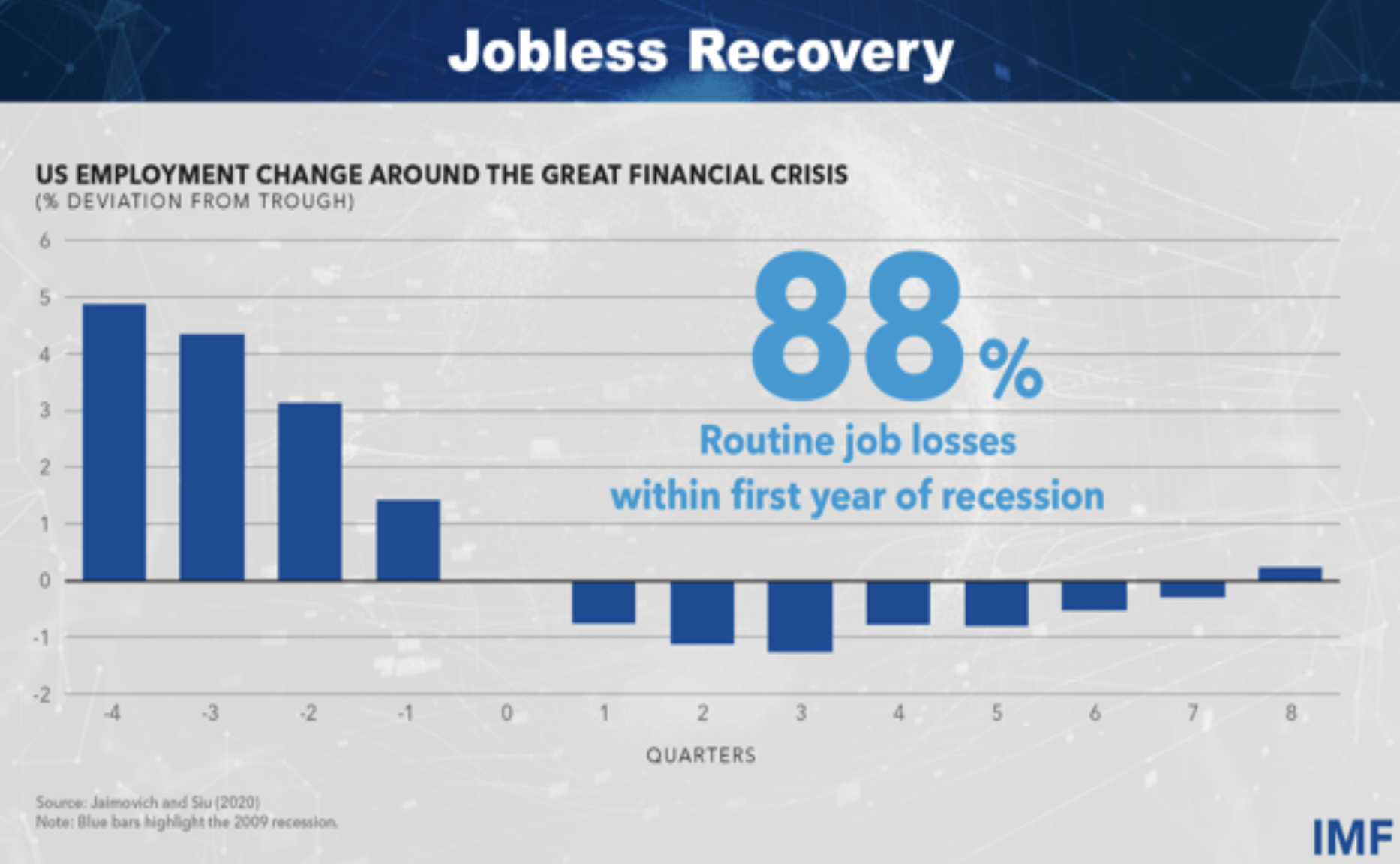
Displacement could be sudden. In particular, markets are concerned about a potential rapid collapse of demand for historically well-paying occupations such as software engineers, financial analysts, and legal associates, which could trigger cascading effects. Research suggests that up to 90% of automation-related job losses occur during the first year of recessions. If an increasingly unequal economy encounters a sudden slowdown, labor displacement could be both sudden and concentrated. The initial shock would be further compounded by the second-order effects of reduced tax revenues, weakened consumer demand, and wage scarring (the long-term negative impact of unemployment on an individual’s wages).
One remedy is to modernize and scale active labor market policies. Among the most popular solutions to these near-term risks are policy interventions aiming to help people find and keep jobs. Wage insurance programs have shown promising empirical evidence to improve worker outcomes during transition periods. For instance, Germany’s Kurzarbeit helped it avoid rising unemployment during the 2008 financial crisis, making it the only G7 country to do so. Meanwhile, the US’s Reemployment Trade Adjustment Assistance program is estimated to have increased employment probability by 8% to 17%, and it largely pays for itself through higher tax revenue and reduced benefit outlays.
/inline-pitch-cta
Reskilling programs have also been widely discussed among policymakers, though it is still unclear what industries workers should be retraining for. Other proposals include dynamically expanding unemployment benefits or job guarantee programs that could provide transitional public employment.
To strengthen these programs, governments must invest more significantly in labor market data, streamlined benefits systems, and payment infrastructure—the absence of which hampered COVID-era relief distribution globally. These investments, made in the near term, can also help to develop the infrastructural backbone for more ambitious medium- and long-term interventions.
In the medium term, the transition to an economy dominated by AI will present both extraordinary opportunities and structural risks. As AI systems become increasingly capable, they will be able to complete ever more workstreams end-to-end, potentially driving broader job displacement than seen in the near term. A new class of superstar firms might emerge in winner-takes-all markets where scale—especially of compute and capital—could confer decisive advantages. The medium-term period could be defined by a delayed but rapidly accelerating impact on productivity and employment, an increasing divergence in AI adoption and growth between regions and countries, and growing pressure on fiscal systems.
Differences in AI adoption may drive divergent outcomes for countries. Since countries will adopt and develop AI unequally, the impacts on productivity are also likely to differ. This could contribute to increasing global inequality, especially when technological diffusion is limited (e.g., by export controls, protectionism, or regulatory barriers). The White House Council of Economic Advisers warns that countries lacking the ability to develop advanced AI face compounding disadvantages that could produce a second Great Divergence, paralleling the Industrial Revolution.
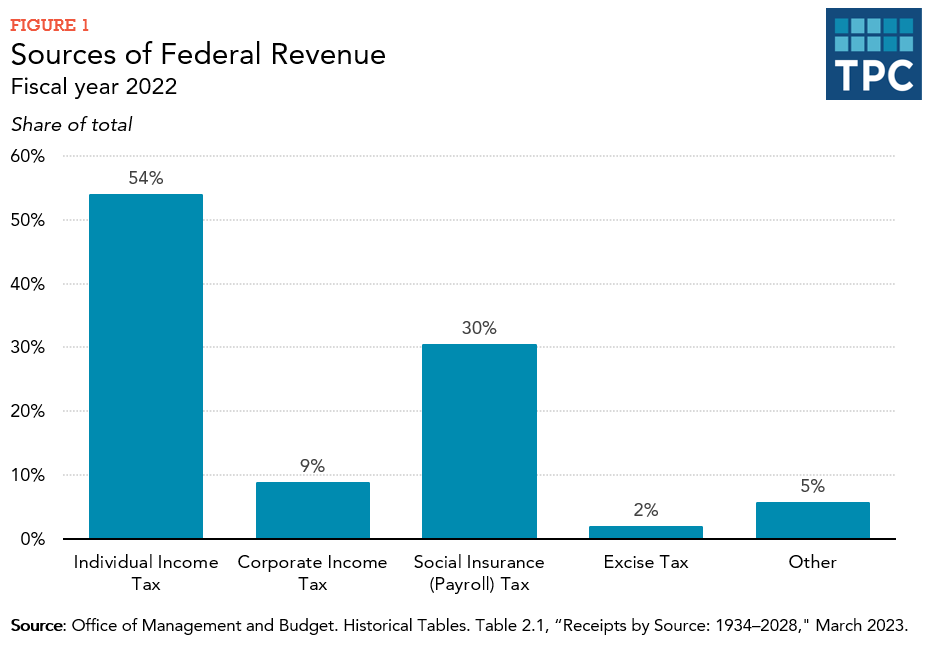
Widespread labor displacement could substantially impact tax revenue. If new economic growth is increasingly captured by a smaller proportion of AI-led corporations, tax systems built primarily around payroll taxation could face revenue shortfalls and a structural mismatch between where value is created and where it is taxed. Globally and in the US, labor revenue is typically taxed at a significantly higher rate (and more effectively) compared with how capital is taxed. A substantial shift of economic growth toward capital could therefore lead to multi-digit percentage declines in revenue.
Several common themes in today’s policy conversation could help to address the medium-term economic impacts of AI.
Policymakers will need to begin considering taxation reforms. Leading economists have proposed a shift toward consumption-based taxation if labor income declines in importance. By capturing spending rather than earning, higher consumption taxes would sidestep the question of labor versus capital income. A contrasting approach centers around progressive corporate taxation, which would impose higher marginal rates on the most profitable multinational enterprises through global coordination. Alternatively, token taxes could capture revenue streams directly from leading AI corporations. Any of these measures alone might be insufficient; an effective fiscal response would likely need to combine approaches to create a tax code with adequate resilience and fitness for future scenarios.
Countries could strengthen their economies by fostering AI-related industries. As economies grow more focused on AI, countries will need to consider active industrial policy, primarily to aid their economic competitiveness and stimulate job creation in increasingly important industries. Ramping up AI infrastructural investments is already a mainstream discussion in most countries, where we are seeing proposals to increase capital inflows, create special “AI Growth Zones,” and subsidize data center investments. Emerging ideas include publicly owned AI foundation models or tax breaks incentivizing employers to invest in worker retraining or human capital development.
Governments may need to actively protect vulnerable workers and industries. Labor subsidies targeting socially valuable sectors could preserve employment where human participation generates positive externalities, such as education or elderly care. For example, in 2021 South Korea’s Senior Employment Program provided work for roughly 840,000 people over age 60. Elsewhere, leading economists have proposed a series of policies to encourage “pro-worker AI”: deploying assistive AI that makes workers more productive, instead of outright replacing them. Strengthening collective bargaining rights may also play a key role in determining whether organized labor can secure meaningful leverage for workers.
By making such investments in the next decade, governments will determine whether they can protect workers in a medium-term future where new economic growth becomes increasingly dominated by capital. These measures could also lay the foundation for managing the largest economic impacts of AI over the long term.
Provided we avoid the more extreme risks of AI, a likely trajectory of the technology is that it eventually surpasses humans across an increasing proportion of economically valuable tasks. Machine intelligence faces fewer fundamental constraints than its biological counterpart. AI will continue to decrease in cost both for cognitive labor—which is already price-competitive with humans on many tasks—and eventually for manual labor, which will be constrained primarily by the marginal cost of robotics systems.
/odw-inline-subscribe-cta
AI could automate a steadily increasing proportion of new economic growth. In the long run, there may be few persistent bottlenecks to automation as the economy restructures around powerful AI systems. Durable human advantages may persist primarily in domains requiring interpersonal connection or physical presence, as well as in contexts where people specifically prefer human involvement.
Automation could change the social contract. This transformation could challenge the foundational premise of modern economies: that hard work and talent are the primary route to income and economic security. If labor ceases to be a reliable path to capital accumulation, core aspects of the social contract may break down for a growing share of the population. Eventually, the policy challenge may shift to fundamentally redesigning the relationship between citizens and the economy itself.
Many ideas for meeting this challenge have been suggested, beyond the call for universal basic income.
Equity and capital may need to be predistributed. Many recent proposals have centered around fractional public ownership of AI equity, requiring that AI firms transfer equity to governments, which would own them on behalf of the public. Unlike universal basic income, which requires perpetual political will, redistributing capital would create durable property rights that compound over time. Leading economists such as David Autor and Neil Thompson argue that we should begin experimenting with universal basic capital (UBC) now, as, even in the most ambitious cases, it would take multiple decades for capital ownership to be broadly diffused.
Sovereign wealth and international coordination may help to distribute AI benefits. Sovereign wealth funds (SWFs) have emerged as a widely discussed institutional vehicle for public co-ownership, with promising examples in Norway and Alaska. By holding equity stakes in AI firms and infrastructure, governments could become better invested in the long-term success of AI and eventually distribute these gains to citizens via cash dividends or public services. Globally, an increasing divergence between countries that produce AI and countries that consume it may eventually lead to calls for stronger international institutions, multilateral tax coordination, or even dividend funds on behalf of all humans.
Governments may provide universal basic services. In the long run, governments may choose to expand the direct provision of essential services—including health care, child care, and education—so that they are fully decoupled from employment status. The UK's National Health Service, Finland's free university system, and Vienna's social housing model demonstrate that universal basic services can be administratively feasible and politically durable.
With a combination of these policies, it is entirely plausible that in highly automated and productive futures, governments could ensure a basic level of economic security for all citizens. The open question is whether the political will to do so will exist.
The exact policy interventions will differ dramatically on a country-by-country basis. There is no single policy roadmap that will work everywhere; each government will need to design a strategy uniquely suited to its own citizens, culture, and institutional context.
Each stage of interventions can help create the infrastructure for the next. In many cases, the policy proposals described above help to lay the groundwork for navigating later stages of the economic transition, as well as having immediate benefits during the stage at which they are implemented. Building social safety nets today may enable greater bargaining power for labor later. Strengthening taxation mechanisms eventually supports funding for broader public service provisioning. Effective economic policies compound: they succeed as deeply interwoven networks over decades of investment.
Nations will need to develop their own economic preparedness plans. Governments should develop self-assessments and policy strategies tailored to their specific labor market exposure to AI. By evaluating a wide range of potential scenarios, countries can test their preparedness for highly uncertain futures. Only with that foundation can they develop strategic policy roadmaps for the transition ahead.
Policymakers globally are just beginning to recognize that the intersection of AI and labor will be a defining theme of upcoming elections. Within a few years, this will likely become a core issue for political candidates around the world. Yet governments are not remotely prepared to offer coherent responses on the scale these challenges will require. If we can support our policymakers with better foresight and more coherent roadmaps to economic success, we may be able to guide this upcoming transition toward prosperity and widely shared financial security.
See things differently? AI Frontiers welcomes expert insights, thoughtful critiques, and fresh perspectives. Send us your pitch.

Utilitarians at AI companies imagine a cosmos filled with blissful AIs. They might risk human extinction to achieve it.

Public-key encryption keeps your messaging and web browsing private, but it depends on shaky math assumptions. AI-powered math might break it.