An AI Capabilities Gap Can Endanger Nuclear Deterrence
For decades, no nuclear power could disarm its rivals without provoking devastating retaliation. A large AI lead could change that.
Jun 25, 2026

Since the late 1950s, Mutual Assured Destruction (MAD) has served as a limiting factor on great-power conflict. The doctrine holds that, if two opposing nations have nuclear weapons that can survive one another’s initial strike, then the near-certainty of devastating retaliation will deter each side from launching a large-scale nuclear attack. Despite this logic, military planners have long considered the possibility of a counterforce nuclear attack, where a superpower uses nuclear weapons to cripple the nuclear capabilities of its enemy. If such an attack were executed preemptively, as a so-called “first strike,” it could both start and end a great-power conflict in a matter of hours: without retaliatory capacity, the defender would be at the mercy of the aggressor’s remaining nuclear weapons and forced to surrender.
The reason this does not happen is that a truly successful counterforce strike is nearly impossible to pull off: a would-be attacker doesn’t know the locations of all opposing missile launchers and submarines, nor does it have missiles with sufficient precision and speed to destroy opposing missile silos before they could launch retaliatory nuclear warheads. Thus, if provoked by a first strike, the opposing side would likely be able to launch a large-scale nuclear response, and the attacker, unable to counter all enemy missiles, could face devastating losses. The result of a preemptive counterforce strike, in other words, would be mutual assured destruction.
AI could change this dynamic. By the mid-2030s, AI-assisted research and development could reduce the cost required to develop and manufacture military hardware by an order of magnitude. Such lower costs could enable a nation with an AI lead to quickly and cheaply build military infrastructure projects, making nuclear counterforce strikes a realistic possibility. Nations with weaker AI capabilities would struggle to quickly build the countermeasures needed to retain a credible nuclear deterrent.
This article will primarily be a technical assessment of how AI could undermine nuclear deterrence, although I’ll lightly touch on a few political aspects. For a longer and more in-depth assessment of the factors discussed here, consider taking a look at an earlier piece I wrote.
In any preemptive counterforce strike scenario, the attacker is at a large disadvantage compared with the defender, because they must destroy all of the defender’s nuclear weapons. To execute a counterforce strike, the attacker must achieve all the following requirements simultaneously:
Suppress launch on warning. Many nuclear-armed nations have a policy of launch on warning—launching a retaliatory strike based on sensor data, before a nuclear weapon has been confirmed to land on their territory. The attacker must either use fast-arriving weapons or otherwise disable launch on warning.
Locate and destroy nuclear submarines. Nuclear submarines, while extremely stealthy, are vulnerable once detected. Each nuclear submarine can carry and launch hundreds of warheads. The attacker must accurately track their locations in real time and destroy them all within minutes.
Locate and destroy mobile launchers. China and Russia (although notably not the US, the UK, or France) each field a set of mobile missile launchers that can be dispersed during times of high alert. These mobile launchers are extremely difficult to locate for long enough to successfully strike. However, if accurate and up-to-date position data can be provided, they are easy to destroy.
Destroy all silos. Hardened silos have known positions, but they require almost a direct hit—ideally with a nuclear weapon—to ensure their destruction. They stand out among nuclear launch platforms, as they have the fastest reaction time and the hardest-to-disrupt communications.
Defend against surviving missiles. If the attacking nation has a functioning missile defense system, it may not need to destroy all of an enemy’s nuclear weapons, as its missile defense can handle some leftovers. The stronger a nation’s missile defense, the less thorough its first strike has to be.
Overcome the nuclear taboo. One theory for why nuclear weapons are rarely used is the nuclear taboo. The leaders of both the US and the USSR recognized the gravity of nuclear weapons usage, and had serious humanitarian reservations about starting a nuclear conflict. Even if a counterforce strike were perfect, radioactive nuclear fallout was expected to kill tens of millions in the target country.
/inline-pitch-cta
The six requirements above have thus far preserved deterrence not because they are physically impossible to meet but because meeting them at the scale required has always been prohibitively expensive.
A useful paradigm to consider in nuclear conflict is the cost-exchange ratio. When one side fields an additional weapon, how much must the other side spend to neutralize it? The concept comes from the Cold War debate over ballistic missile defense. If an attacking nation can build another nuclear missile for $1 million, and the interceptor needed to stop it costs the defending nation $10 million, then missile defense is a losing game: each $1 spent on offense forces a $10 expenditure on defense. This particular cost-exchange ratio explains why a nation launching a counterforce strike would struggle to defend against surviving missiles.
AI-assisted military R&D could invert the cost-exchange ratio. If a nation with an AI lead can automate most of the design, systems integration, and production labor that currently makes military infrastructure expensive, that nation’s costs could be significantly reduced while its enemies’ costs stayed the same (since they don’t have the AI advantage). If interceptors cost only $100,000 and missiles still cost $1 million, then it suddenly becomes rational to build more interceptors.
The likelihood of this prediction’s coming true rests on answers to two questions: (1) whether AI can automate most of the intellectual labor, and (2) whether doing so really cuts costs by a margin significant enough to change militaries’ economic calculus. Notably, this forecast does not require progress in robotics, which could further reduce costs. I'll focus on aerospace manufacturing, which comprises most of what the attacker needs to build: new missiles, surveillance constellations, and missile defense systems.
Can AI automate most intellectual labor? Aerospace projects of the type I’m describing here are highly interdisciplinary, and even simple systems demand expertise in electrical, computer, and mechanical engineering. More-advanced projects may require fundamental research in applied physics or math. While AI assistance for software development is a relatively mature use case, AI abilities in the other fields are much more nascent.
Yet there is good reason to believe that most intellectual fields will follow the same trends. AI abilities have increased at roughly the same rate across various domains, as shown in the chart below.

Additionally, we’re already beginning to see AI labs show interest in automating science and engineering fields: Anthropic is training on electrical engineering, and the company showcased 3D modeling performance in its Claude Fable 5 launch post. OpenAI has made discoveries in mathematics and physics. On the biology front, Google DeepMind’s AlphaFold has solved protein folding, enabling advances in drug discovery.
Extrapolating from such innovations, one engineer could do the work of many: outsourcing most of it to agents and handling only what agents can’t yet do, like running experiments or meeting stakeholders in person.
How much can automated intellectual labor lower military R&D costs? Although aerospace manufacturing seems like a labor-heavy job, it’s a remarkably white-collar profession, with high exposure to AI automation. In a 2021 article, Princeton University computer scientist Edward Felten and co-authors calculated that aerospace manufacturing has an AI Industry Exposure Score of 0.519, in the 70th percentile of all industries (around the same level as real estate). If AI automates the intellectual labor of aerospace manufacturing, this would substantially lower the cost of the final product.
To make things more concrete, consider SEC filings showing the financials of two public launch services companies, Rocket Lab and Firefly Aerospace.
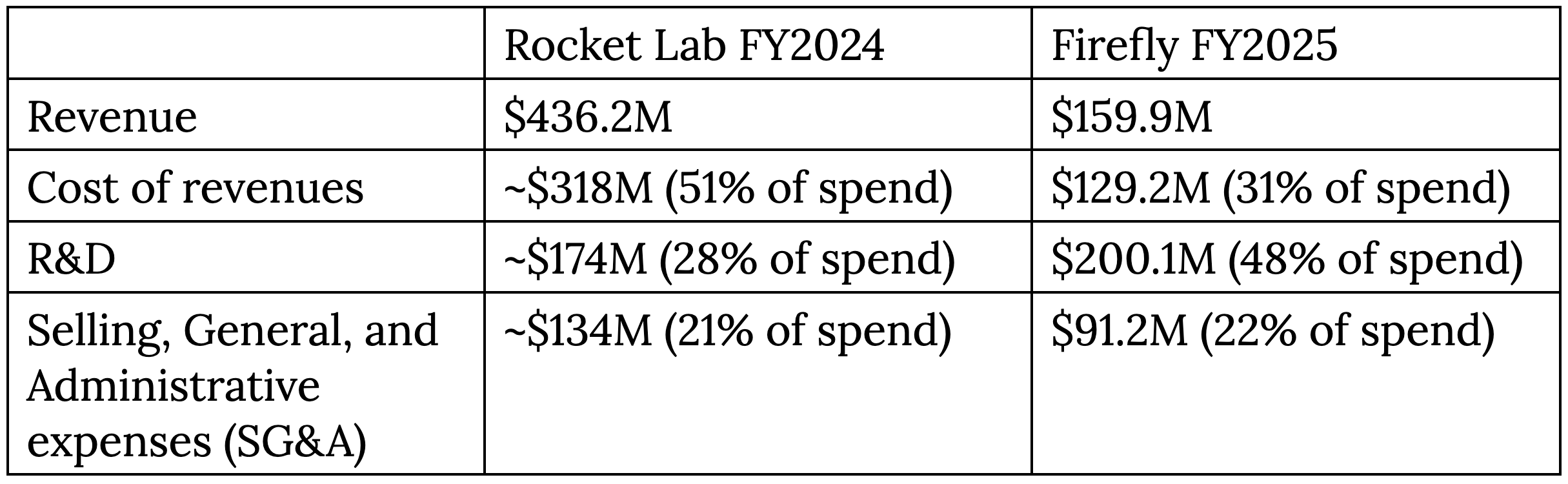
R&D (which accounts for 28%–48% of spend at the two companies) is mostly engineering compensation and analysis, with the remainder going to propellant, test facilities, and hardware. It’s mostly cognitive labor, and therefore a potential target of future AI automation. SG&A expenses (21%–22% of spend) describe the cost of finance, legal, contracts, compliance, and business development. These disciplines rely almost completely on cognitive labor. Cost of revenues (31%–51%) is the most mixed category: it blends physical labor (technicians doing welding, assembly, and launch operations) with white-collar labor (manufacturing, quality, and test engineering), and purchased materials and components.
The costs of aerospace components are themselves quite compressible. For example, star trackers (devices used by satellites to measure their own orientation) can cost over $100,000. These devices’ physical components—a camera sensor, a housing, and some processing hardware— may cost as little as a few thousand dollars altogether. The more significant cost comes from qualification testing and R&D (because of low manufacturing volume, such costs can’t effectively be amortized). So, by reducing the cost of R&D, automating intellectual labor can drive down component costs.
/odw-inline-subscribe-cta
I expect the cost savings to be even greater for defense aerospace products, which usually cost more than comparable commercial products. This higher cost partly reflects the increased documentation and security practices required for highly regulated uses. Such regulatory compliance practices rest almost entirely on cognitive labor that can be automated. Another driver of these product’s higher costs is costlier labor: defense contractors must have security clearances, limiting the worker pool and raising wages. An AI, on the other hand, must be cleared only once; it can then be scaled indefinitely.
Recall the six requirements that have kept a counterforce strike out of reach. Each one has held not because it was physically impossible, but because meeting it at scale was prohibitively expensive. Once cheap intellectual labor collapses those costs, an attacker with an AI lead could pursue several military megaprojects at once, each one solving a different requirement needed to launch a successful counterforce strike. This section will focus on the three requirements I expect to become significantly easier to meet.
Locating and destroying nuclear submarines. Research has shown that, in certain conditions, moving submarines leave a surface wake detectable by Synthetic Aperture Radar (SAR), a space-based radar system. A large constellation of SAR satellites would permit near-continuous surveillance of the entire world, regardless of time of day or local weather conditions. The US is already pursuing a SAR satellite constellation, and will launch its first satellite in 2028. The US could supplement this effort with a space-based constellation of Light Detection and Ranging (LiDAR) satellites. Each satellite would measure depth via pulses of intense light, detecting even stationary submarines (although that would require clear weather). Certain frequencies of LiDAR can detect submarines within 200 meters of the surface, within typical nuclear submarine operating depths. A dense constellation of LiDAR and SAR satellites could sweep the oceans, and expose submarines at scale.
However, while both satellite methods can reveal submarine positions temporarily, the only tool to keep track of them consistently would be underwater drones (often called Unmanned Underwater Vehicles, or UUVs). UUVs are currently limited by the difficulty of autonomous operation, but AI R&D would likely significantly improve this. The US has been funding research in this direction.
Defending against surviving missiles. A system with tens of thousands of interceptors prelaunched in space (similar to the 1980s Brilliant Pebbles concept, originally abandoned due to cost issues) could counter any missiles that are missed by the first strike. The US is already pursuing this, too, with its Golden Dome system.
Overcoming the nuclear taboo. The missiles of the Cold War had poor precision, so warheads with an explosive yield of hundreds of kilotons were common (designed to guarantee a silo kill). But, as mentioned, such heavy warheads would result in enough fallout to guarantee millions of deaths. In 2017, Keir A. Leiber of Georgetown and Darryl G. Press of Dartmouth found that modern missiles have much higher precision than those from the Cold War, and future improvements could reduce the average targeting error to mere meters. With such high precision, very low-yield weapons could be used, with little to no fallout. A counterforce strike could be accomplished with an estimated death toll of around tens of thousands rather than millions, well within the range of wars nations are willing to start.
Other aspects of the retaliator’s deterrent are vulnerable to AI R&D too. The retaliators’ mobile missile launchers can be located with the exact same SAR constellation that we discussed for submarine detection, leaving them vulnerable to a first strike. Launch on warning systems are also vulnerable. While it’s unlikely they could be hacked outright, Anthropic’s Mythos demonstrated AI driven vulnerability discovery that could be used to confuse, delay, or reduce confidence. Additionally, the defender’s early warning response time can be shortened significantly with depressed trajectory submarine-launched missiles, which could cover 2000 km in only 10 minutes. The combination of high-speed and precise missiles also works to efficiently counter fixed silos.
If a lagging nation realizes that a rival is on course to achieve nuclear primacy—the ability to execute a counterforce strike without retaliation—it still has a few options.
The first, and most straightforward option is to expand the arsenal. It can increase the number of silos, build more nuclear submarines and mobile missile launchers, and raise its level of alert. This strategy would work in the short term, since the attacker would be forced to scale up its own forces until it was certain it could neutralize all of the new forces. The problem is the cost-exchange ratio. If the attacker has an AI advantage, the retaliator could end up paying a larger price for each new silo than the attacker pays to build the missiles or interceptors that could defeat it.
The second option is to target the root cause: the AI gap between the attacker and retaliator. Potential avenues in this direction can range from relatively diplomatic to highly escalatory. Options include disrupting the attacker’s supply chain, launching data poisoning attacks, or sabotaging its AI training runs. However, the most extreme actions—direct kinetic attacks on datacenters or researchers—would be likely to start wars. But even these interventions will only be effective if applied early. Once the lead is large enough, sufficiently smart AIs will already be trained. Thus, an AI-lagging defender must be alert enough to act before the AI capability gap becomes overwhelming.
Finally, the attacker and retaliator could negotiate a treaty. A bilateral arms-control regime could in principle cap satellite constellations, ballistic missile interceptors, or AI compute used for military R&D. There is precedent here, especially in the nuclear domain. However, the main challenge will be aligning incentives. The leading nation has no incentive to join a treaty where only the lagging party stands to gain. Traditional arms-control treaties have only worked where there were symmetric costs on both sides.
In conclusion, the historical robustness of nuclear deterrence has rested on a cost-exchange ratio that favors the retaliator, but AI-assisted R&D can invert the ratio. This might enable a single superpower leading in AI to achieve nuclear primacy. The AI superpower would then wield enormous leverage, as it could credibly threaten to win just about any war. Such negotiating leverage could reshape the global balance of power, even if nuclear weapons are never used.
Even before military infrastructure megaprojects are complete, they will affect policy. If major powers come to believe that AI R&D may make their nuclear deterrents less effective, they will have incentives to expand arsenals, shorten decision timelines, rely more heavily on launch on warning, contest one another’s space architectures, and target the AI and semiconductor bases that underpin their adversaries. This new equilibrium would increase military spending, shorten decision times, and raise the risk of war.
See things differently? AI Frontiers welcomes expert insights, thoughtful critiques, and fresh perspectives. Send us your pitch.
Consciousness, sentience, and agency are three ways that something could matter morally. In AI, unlike in animals, they may not come as a package.

Utilitarians at AI companies imagine a cosmos filled with blissful AIs. They might risk human extinction to achieve it.