Hyperlaw: AI Will Change How Law Evolves
As AI makes legal work significantly cheaper, the burden on courts may increase. Some areas of law could see precedent shift faster as a result.
Aug 17, 2026


History shows that new technologies have often brought about significant changes in the law. The proliferation of rail and heavy machinery during the Industrial Revolution increased the number and severity of accidents. This spurred a shift from strict liability (businesses were liable for harm caused by their activities) to negligence (businesses would be held responsible if they failed to take reasonable care) in cases involving railroad and industrial accidents. Then, in the 20th century, as consumer goods became more complex and supply chains grew, it became much harder for consumers to prove negligence on the part of the producer if a product was faulty. This drove the rise of strict products liability, shifting responsibility for defective products toward manufacturers.
Today, the emergence of AI offers a rare opportunity to analyze how the law will change in response to an altogether different kind of innovation: a labor-augmenting technology that is especially likely to change lawyer productivity.
In a recent paper, I argue that AI is likely to alter the speed of the law’s evolution. The technology will likely impact two core areas of law: contracts, which help to delineate rights and responsibilities of each party in advance of an agreement, and litigation, which is the process of determining responsibility after a dispute. Here, I describe how AI is likely to make both contract-writing and hiring trial attorneys cheaper. I then trace how that could accelerate the law’s rate of change in certain domains—a phenomenon I call hyperlaw.
AI productivity boosts will make both contracts and litigation cheaper. One of the most striking aspects of AI in law is how much it raises user productivity. Jonathan Choi and coauthors find that AI boosts legal task completion speed by 12%–32%. In a follow-up paper, Daniel Schwarcz and coauthors find that AI increases the overall productivity of law students doing legal tasks by as much as 130%. These effects will only continue to grow; over the next year, AI agents will likely be able to completely replace the first draft of most legal writing, with lawyers pivoting to just reviewing and commenting on such drafts. These productivity boosts will likely reduce the costs of both writing contracts and litigating disputes.
Cheaper contracts and litigation have opposite effects on demand for courts. First, AI will help attorneys write more complete contracts that preassign responsibility for more and more possible outcomes of an agreement. This could reduce the likelihood of an event in which responsibility has not been predetermined, lowering the number of disputes and weakening the demand for courts. I dub this the contracting effect. Second, cheaper litigation could reduce the need for complete contracts and reduce litigants’ incentive to settle a dispute out of court. This would boost the demand for courts, a result that I call the litigation effect.
The speed at which the law evolves depends on the number of court cases. When litigation overturns precedent, changes in the demand for courts, as outlined above, will affect how quickly the law evolves. Should litigation become less common (thanks to more complete contracts), the law’s evolution will slow. But should litigation become more frequent, the law will evolve more quickly.
These effects will vary across legal domains. At first glance, the likely net effect of AI on the law’s rate of change is ambiguous. Contracting and litigation effects offset one another. But neither effect will apply equally to every area of law. Where contracts are rare, as in tort law, legal change is likely to accelerate. Where contracts are common, as in property and contract law, the outcome is less certain.
Despite this ambiguity, there is good reason to think the law will feel some effects soon. For example, the three main tasks of an attorney are legal research, legal argumentation, and legal writing. Each involves producing or digesting large quantities of text, which is the attorney’s forte—and also AI’s. Attorneys have noticed. A 2026 Thomson Reuters survey found that 40% of attorneys across 27 countries worked in offices using AI. A year earlier, the figure was 22%.
To see why AI could shape the speed with which the law evolves, let us consider the incentives to (1) implement a written contract and (2) litigate. The former influences how often disputes occur. The latter influences the rate at which parties pursue dispute resolution in court. Insofar as AI impacts each, courts will have more or fewer opportunities to tweak precedent.
/inline-pitch-cta
The risk of disputes turns on a trade-off in costs between contracts and litigation. Suppose that a man named Quincy wants to buy a used van from a woman named Genevieve. It is hard for Quincy to foresee all the ways in which a dispute may arise. For example, the van’s battery could die a month after the sale, and Genevieve could refuse to pay for it.
Quincy has two ways to deal with the dispute risk. The first tries to avoid the costs of resolving a dispute after the fact. It involves hiring an attorney to delineate property rights up front, in a thoroughly written contract. For example, the pair may agree that Genevieve will pay for a new battery, tires, windshield wipers, and some routine maintenance for up to six months after sale, while Quincy will handle all other repairs in perpetuity. Such a contract, in principle, aims to avoid future disagreements by defining responsibility for some of the many potential problems with a used vehicle beforehand. If something goes wrong with the van after sale, the parties need only consult the contract to figure out who is responsible for repair costs.
The second option tries to save money on the up-front costs of producing a contract. In this case, Quincy can leave the contract relatively incomplete or unwritten. A less thorough contract might stipulate that Genevieve pay for a new battery but refrain from delineating responsibility for the many other possibilities. This alternative implies a mutual agreement to delineate responsibility later via dispute-resolution forums like courts. Should Quincy go this route, he avoids contracting costs but is more likely to pay for costly litigation.
Most contracts are incomplete, as filling gaps offers diminishing returns. Quincy benefits from making his contract more complete, but filling each gap requires attorney time (which costs money) and negotiation with Genevieve. Thus, a sensible strategy is for Quincy to address only the most important and likely issues, while leaving less critical issues unaddressed. Put differently, Quincy should improve his contract until the marginal cost of filling a gap exceeds the marginal benefit of filling it. His final contract is likely to be partly incomplete. Some gaps are just not worth filling.
AI has two offsetting effects on how incomplete contracts will be. AI makes attorneys more productive in writing contracts by, for example, automating drafting and reviewing, implementing longer and more complex clauses, and identifying gaps that might otherwise go unseen. That reduces the marginal cost of gap-filling, meaning that, all else being equal, the final contract is likely to be more complete. A more complete contract leaves fewer losses unassigned, with fewer occasions for disagreement. The demand for courts is lower.
But AI also reduces the benefits of making a contract more complete in the first place. Hiring an attorney is one of the chief costs of dispute resolution after the fact, and AI makes trial attorneys cheaper per task by making them more productive. The cheaper trial attorneys become, the lower the cost savings Quincy can expect to earn from making his contract more complete. As a result, AI can also make it economical to write less complete contracts. Why pay for a complicated, custom contract when hiring a trial lawyer is relatively cheap? In this case, the demand for courts is higher.
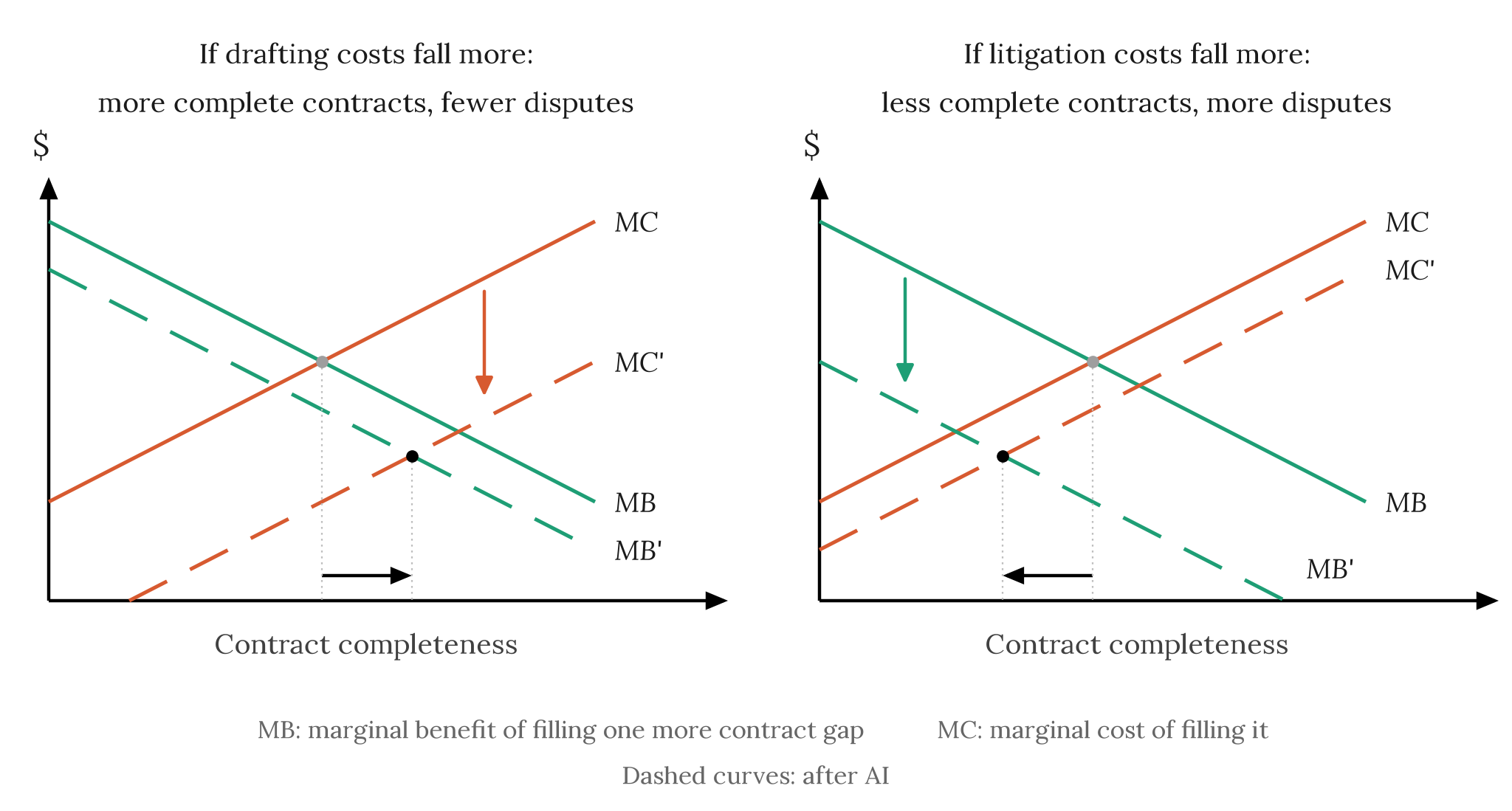
AI’s net effect on contract completeness and the number of disputes is unclear. The direction of AI’s net effect depends upon which cost AI reduces more: the cost of gap-filling or the cost of disputing. If the former falls by a greater percentage than the latter, then parties will fill more gaps in contracts and end up in fewer disputes. If the reverse occurs, then parties will fill fewer gaps in contracts and end up in more disputes. Which effect will dominate is difficult to predict.
Although the overall effect of AI on the number of disputes is ambiguous, it is likely to increase the chance that any given dispute goes to trial. The reason is that AI makes litigation cheaper relative to settlement.
Suppose that Quincy is unlucky. His used van breaks down. Suspecting that Genevieve was careless, Quincy wants to recover his costs, whether through settlement or at trial. Genevieve wants to minimize her costs, whether through settlement or at trial.
/odw-inline-subscribe-cta
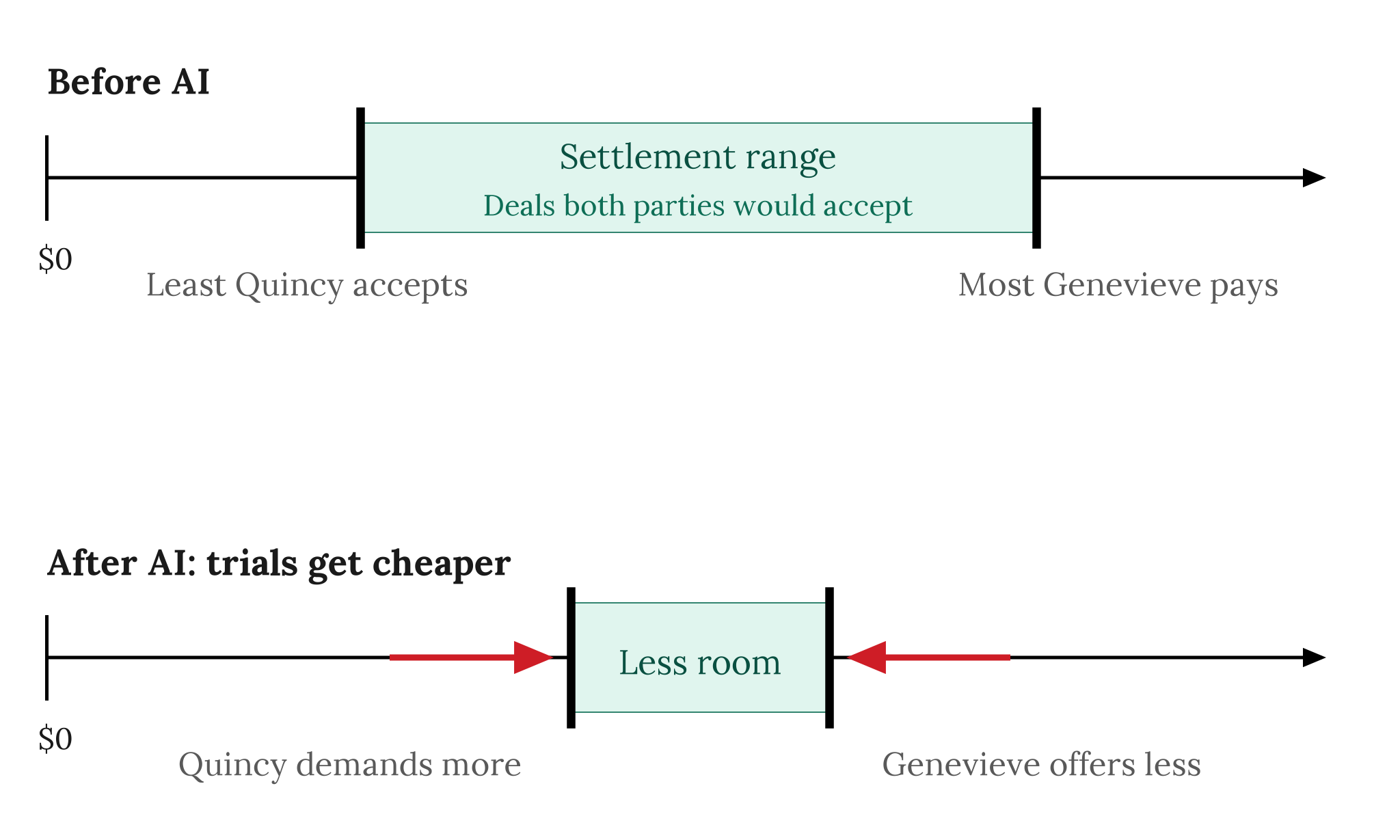
Settlement is only possible if neither party thinks they could gain by going to trial. Quincy will accept a settlement only if it offers him at least as much as his expected benefit in going to trial: his chance of winning times the compensation amount ordered, minus his litigation costs. Genevieve will pay a settlement only if it is no larger than her expected cost of going to trial: her chance of losing times the ordered compensation, plus her litigation costs. Settlement is possible only in the overlapping range between Quincy’s minimum acceptable compensation and the maximum sum that Genevieve is willing to pay.
Cheaper trial litigation makes disputes less likely to settle. The litigation effect reduces the cost of going to trial for both parties. Quincy’s minimum acceptable payment therefore gets larger, and the maximum that Genevieve will pay gets smaller. As a result, the range of possible settlements will shrink, which may mean there is no possible settlement that both parties will accept. AI thus increases the chance that parties take their disputes to trial rather than settle.
An increase in the number of disputes going to trial could mean more than just a higher caseload for lawyers, potentially influencing the law itself.
A larger number of court cases means more opportunities to tweak precedents. Should AI change how often disputes occur (via changes in contract completeness) and how frequently they go to court (due to cheaper litigation), then AI is likely to change how quickly the law evolves. The reason is that the common law evolves as courts tweak precedent, and the rate at which such tweaks occur depends upon how many disputes occur and the rate at which disputes go to trial. An increase in either gives courts more opportunities to change precedent.
Legal change could accelerate in tort law, which lacks the contracting effect. The framework above predicts that AI will not have the same effect on every area of law. Tort law, for example, tends to govern disputes that occur without prearranged contracts, such as accusations of assault or defamation. In such cases, the contracting effect is not present, but the litigation effect is. Cheaper litigation will therefore increase the rate at which the current rules of tort liability are challenged and ultimately overturned, giving courts more opportunities to change precedent in tort law.
In areas of law subject to both effects, results will depend on which effect is stronger. In property and contract law, parties often have the foresight to write detailed agreements. Both the contracting effect and the litigation effect are present, so whether the law evolves more or less quickly depends upon the relative strength of the two effects. In contexts where contracts become more complete, fewer disputes will occur. However, as discussed above, when disputes do occur, parties will be more likely to go to trial rather than settle, giving courts more opportunities to tweak precedent. Thus, the contracting and litigation effects pull in opposite directions, and the common law may therefore evolve more or less quickly depending upon which effect dominates.
By contrast, in contexts where litigation costs fall by a greater percentage than gap-filling costs, relatively more disputes will occur; in any such disputes, parties will be more likely to go to trial. Both margins move in the same direction, and the prediction is unambiguous: the common law is likely to evolve more quickly, because courts will have many more opportunities to change precedent.
If the analysis above is right, what kind of society does hyperlaw produce? It depends. Below I consider three possibilities.
First, hyperlaw implies a body of law that continuously and quickly updates to changing circumstances. The common law took decades to adjust to railroads and assembly lines. By contrast, a hyperlaw system of torts might adjust to autonomous vehicles, for example, in a decade or less. Liability rules for innovations like driverless cars and drones may update continuously and quickly, thanks to cheaper litigation as the technology evolves. But such a system is not without costs. It may also, for example, limit economic growth. The reason is that, if the law changes too quickly, investors will face considerable uncertainty about the rules that govern their returns. In response, they may refrain from making otherwise worthwhile investments.
Moreover, hyperlaw may create opportunities for institutional arbitrage. Insofar as tort law evolves quickly and contract law does not, some litigants may be incentivized to portray contract disputes as tortious, to take advantage of its speedy evolution. Others who prefer stability may instead opt to contract their way out of the courts altogether, taking advantage of reduced contracting costs.
Finally, there is one important reason that hyperlaw may never come to be. The aforementioned possibilities do not occur in a vacuum. Courts that risk being overwhelmed by litigation may offset the effects of hyperlaw by raising filing fees or the requirements for standing, for example. Such adjustments will increase the costs of litigation and, in turn, screen out disputes that may have otherwise tweaked precedent. Ultimately, whether hyperlaw is a realistic future depends upon AI’s legal capabilities and how courts respond to them.
See things differently? AI Frontiers welcomes expert insights, thoughtful critiques, and fresh perspectives. Send us your pitch.
In an excerpt from his new book, Garrison Lovely argues that stopping the AGI race is entirely possible, but business interests stand in the way.
Deterrence can be the starting point for US-China cooperation.