America’s Seed Fund Should Back AI Resilience Startups
AI will create a trillion-dollar resilience industry. The Federal Government can seed its champions today.
Oct 19, 2026


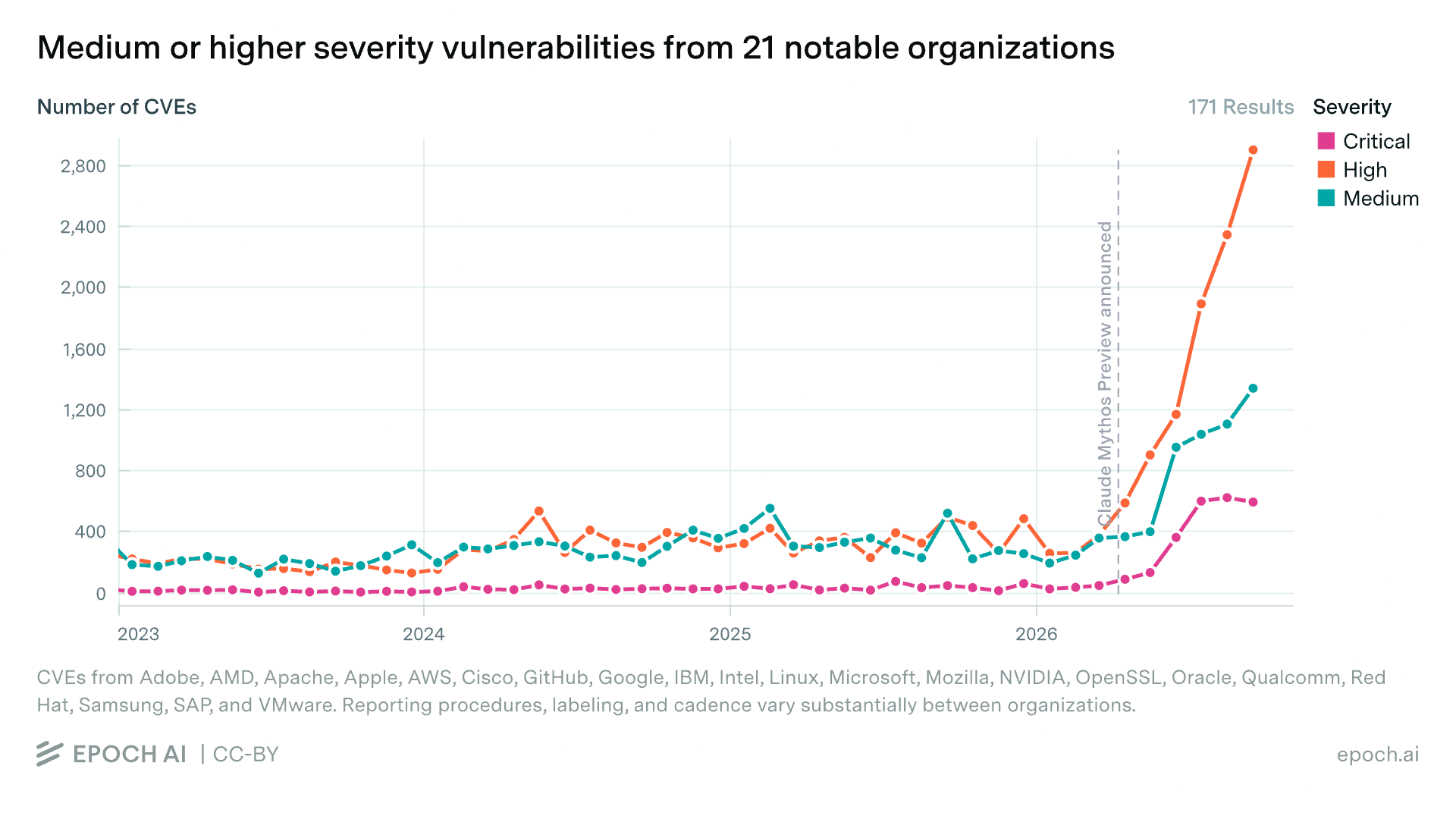
After this spring’s arrival of new AI models with enhanced cyber capabilities, monthly disclosures of serious cyber vulnerabilities at major tech companies have surged far above anything seen in the previous four years. At the same time, headlines about new frontiers, from designing new viral genomes to outperforming world-champion debaters at persuasion, are hinting at the challenges AI innovations may bring.
These developments make plain that, if we are going to harness the benefits of AI, we must also build resilience to its disruptions. Such fortification will require developing new technology. But, even when we can see disruptions coming, there’s a lag between their arrival and their real-world impacts; that lag deters private investors from funding startups that address AI’s risks. If we wait until the market for defensive technologies fully materializes, we will have waited too long to build those technologies. The US government can make these bets now, so that America is ready when the market needs them.
We propose that the National Science Foundation award $100 million over two years to startups defending against AI risks. These grants would flow through America’s Seed Fund, the NSF’s existing program for small businesses developing new technologies. This program, which we call the AI Resilience Pilot, would support tools to prevent, monitor, and mitigate AI-enabled threats. These tools could include software that fixes vulnerabilities in critical infrastructure, systems that constrain autonomous agents, and technologies that can screen synthetic DNA orders.
A resilience technology is one that gives defenders an edge over adversaries, making America hard to attack as AI grows more capable. There are four areas in which AI is changing the threat landscape fastest and defenses can be built today.
Cyberdefense. This includes autonomous safety processes (such as discovery and patching of vulnerabilities, formal verification of critical software, and hardening of industrial control systems). The demand already exists: just last week, hackers remotely overrode the refrigeration controllers at hundreds of French supermarkets, spoiling food and starting fires at an estimated cost of tens of millions of euros.
Agent security. This includes research and development into new infrastructure that can monitor and control increasingly autonomous agents, shutting down or suppressing rogue agents.
Biosecurity. This includes rapid diagnostics for monitoring and controlling DNA-synthesis efforts; responsive countermeasure platforms; and “early warning” pathogen detection (e.g., in wastewater and travel hubs).
Infrastructure and cognitive security. This includes content provenance and authentication technology, analyzing and verifying media (video, voice) to certify that components are human, equipping American citizens and institutions to resist AI-enabled deception at scale.
Startups are a promising vehicle to solve problems like these. They can assemble exceptional teams around a specific mission, move quickly without layers of institutional bureaucracy, and remain grounded in the real world by having to build something a near-future customer will actually pay for.
/inline-pitch-cta
Companies are already breaking ground here. Aclid, a biosecurity company, has received an Air Force small-business research award for screening synthetic-DNA requests. Cybersecurity firm Trail of Bits placed second in the Defense Advanced Research Projects Agency’s (DARPA’s) AI Cyber Challenge, which tested whether and how the discovery and repair of system vulnerabilities could be automated. The open question is how to draw more promising founders to unsolved problems before the need becomes urgent.
An example resilience measure: developing and installing Far-UVC lights. The case for building defenses before a threat emerges is especially clear in biosecurity. The majority of research and development into vaccines and diagnostics are done for pathogens we already know, however a capable AI model could significantly assist an attacker design one which we have not encountered. Far-UVC light offers an incredibly broad defense against airborne pathogens without needing to know them in advance. At a special wavelength of ultraviolet light (222 nanometers), it is able to inactivate airborne viruses and bacteria without damaging humans. In a room-sized experiment, just 5 mounted lamps reduced viable airborne bacteria by 98%. The ambition is to do for air what chlorination did for drinking water. What stands in the way is some ordinary engineering; how much ozone do the lamps generate, what dose is safe across a work day, whether we can build them at an affordable price. It’s the kind of technology that goes unfunded until there is another outbreak like COVID that creates urgent demand.
Timing is the main constraint for many startups that build resilience technologies. Venture capitalists can tolerate technical risk when a company's work is able to resolve the uncertainty on a defined schedule. A biotech startup may have an forecasted one-in-twenty chance of technical success but its trials run according to a calendar. If the drug works, there will be people ready to buy it. Resilience technology companies often have the opposite problem. The engineering problem is ordinary, but investors are not well positioned to predict when the companies can expect paying customers as they arrive when the risk is legible. Or in other words, after an attack or an outbreak has occurred. The result is a market in which nothing unlocks the funding until the harm itself arrives, and in the years it then takes to build the products, the country is left exposed.
Resilience can remain underfunded even when a risk is expected, because buyers can’t or won’t pay its full value. During the 2013–2016 West Africa Ebola outbreak, the World Health Organization emphasized that weak commercial incentives led to lackluster preparation of vaccines and treatments. Today, critical infrastructure like hospitals and utilities should be bolstering their resilience to new AI-enabled cyberattacks, but they may lack the budget to be a startup’s first customer. In 2021, ransomware took one San Diego health system offline; neighboring hospitals had to absorb most of the downside. As the hospitals reached capacity, stroke cases within newly impacted emergency departments more than doubled, from 22 to 47. As this cautionary tale illustrates, a hospital that invests in cybersecurity is partly buying protection for the hospital next door. It is also buying protection for its patients’ insurance providers and for its country’s national security. As President Trump’s Advisors wrote in 2018, cybersecurity externalities “may lead to rational underinvestment in cybersecurity by the private sector,” and firms in critical infrastructure “may generate especially large negative spillover effects to the wider economy.” So the ecosystem of investors, who can back only what customers will pay for, underfund the startups building these defenses.
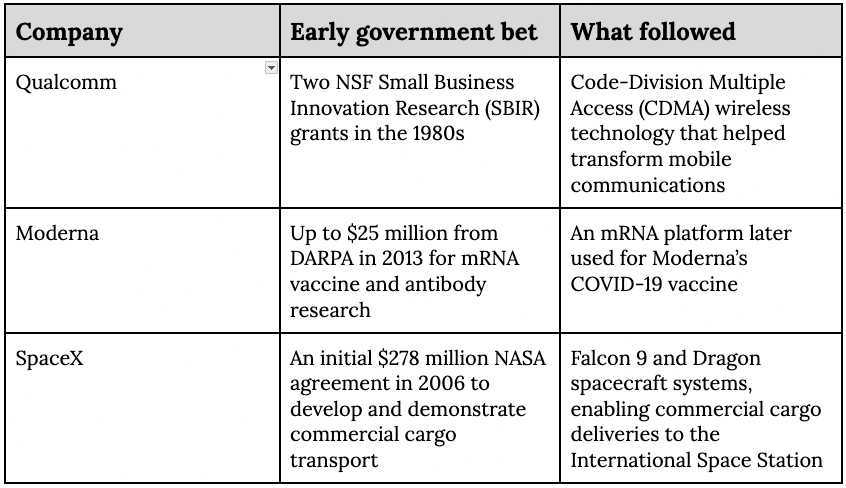
Government funding can help bridge the gap. Historically, the US government has played a pivotal role in moving strategically important technologies from early research to commercialization. Governments can take early bets that are too uncertain for private capital, absorbing the initial risk needed to prove new technologies, create new markets, and ultimately catalyze private investment. And the government, which answers for the wider economy and national security, is the natural party to pay for protection that no single buyer will.
In 1979, the NSF made consecutive awards totaling roughly $250,000 to a four-person company, in Silicon Valley, working on enabling computers to understand English. The specific threat that this company would go on to fight—the computer virus—was not of present concern. This company, Machine Intelligence Corporation, later became Symantec; in 2019, Broadcom bought its enterprise security division for $10.7 billion. The award did not predict the threat precisely, but it funded a capable team early enough that, when the threat arrived, there was an American company ready to meet it.
As an initiative of NSF’s SBIR and Small Business Technology Transfer (STTR) programs, America’s Seed Fund is already providing a path to market for publicly impactful innovations in other industries. For example, it provides nondilutive funding to deep-tech startups: grants require no repayment or equity, and companies retain their intellectual property (subject to standard federal rights). Between fiscal years 2016 and 2025, America’s Seed Fund invested over $2 billion into more than 1,600 companies.
The results speak for themselves: NSF reports that companies receiving seed fund grants raised more than $36 billion in private investment and had around 380 exits during that period.
Government funding can complement current philanthropic funding. America’s Seed Fund is built specifically to fund startups, with an established path for successful companies to receive millions more in nondilutive capital. While some philanthropic organizations fund AI resilience technologies today, an NSF program can reach founders beyond the existing AI safety community, which is made up of a small set of ideologically aligned individual donors. Diversifying the source of investments into AI resilience gives founders greater freedom to pursue solutions that are uncorrelated with any group's judgment about which risks matter. Further, as the philanthropic space becomes increasingly politicized, NSF awards provide a form of legitimacy for investors and customers that signal that this is a national priority.
In 1977, an NSF program manager named Roland Tibbetts noticed something: small businesses were generating a disproportionate share of innovations per dollar spent on R&D. Yet, in aggregate, these firms were receiving just a small fraction of federal funding for R&D, while the rest flowed almost entirely to national labs, universities, and large contractors. Seeking to support the most productive innovators, Tibbetts began carving out a sliver of the NSF budget for competitive small-business research awards. The results that emerged were so strong that Congress decided every agency should do the same. Tibbetts’s sliver has now grown into a federal program that has put more than $82 billion into American small businesses since 1982. At most agencies, like the Department of War, this looks like government contracting.
/odw-inline-subscribe-cta
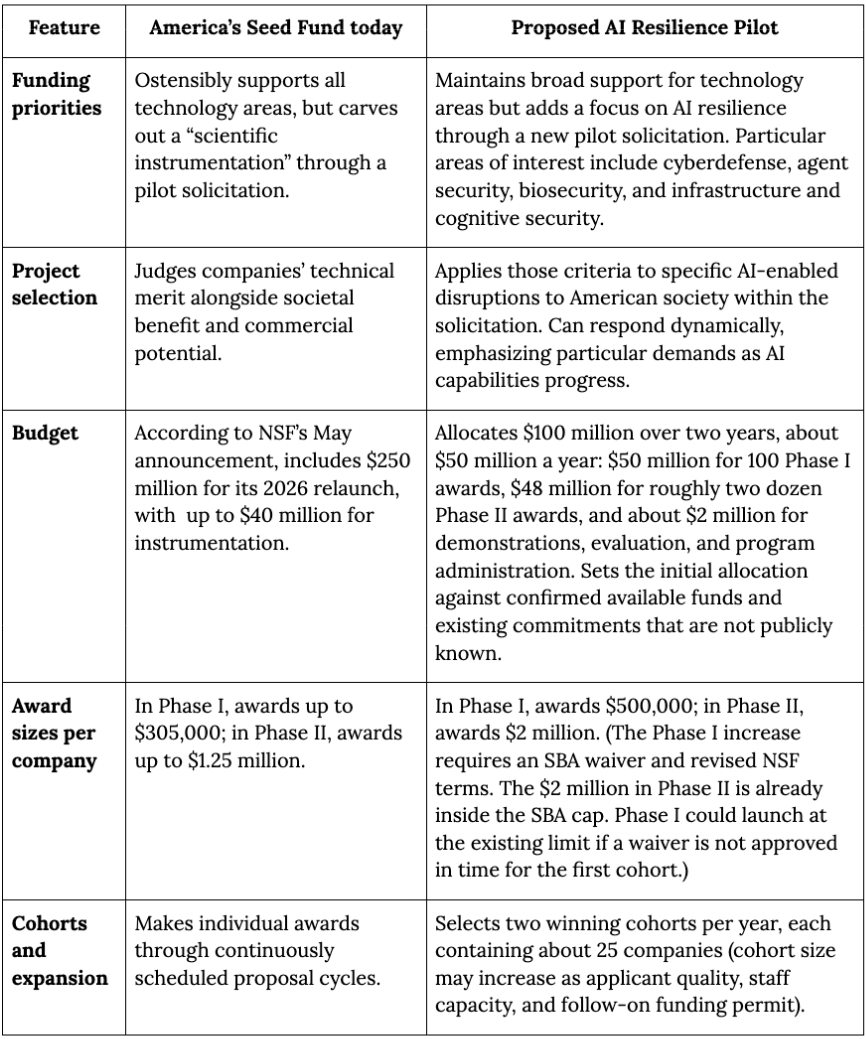
In May of this year, the NSF relaunched the program, with $250 million in anticipated funding, including a companion solicitation of up to $40 million for a “scientific instrumentation” pilot. This carve-out for next-generation instruments offers a practical model for our proposed AI resilience pilot. Specifically, we propose that NSF publish a new companion solicitation, providing $100 million over two years to startups building resilience technologies. At $50 million a year, it is in the same range as the $40 million the NSF has committed to the scientific-instrumentation pilot.
Under this new model, founders would be accepted in cohorts of about 25 companies, twice per year, to build resilience technologies. Sized to match the industry standard for seed checks in startup accelerators, successful founders would first be awarded an initial $500,000 (Phase I). Promising companies can be invited to receive a further $2 million (Phase II) in nondilutive funding. Over two years, this model would fund about 100 companies through Phase I and roughly two dozen through Phase II. Given their size, these awards would require Small Business Administration approval and NSF rule updates; however, they would not require congressional approval. Phase II awards would give teams more room to resolve difficult technical questions and test their work with prospective users. Creating the AI Resilience Pilot would contribute to the growth of the resilience-startup ecosystem and play a crucial role in coordinating prospective customers’ access to support, expertise, and connections.
Importantly, cohort companies would give policymakers a clearer picture of which defenses could be implemented today, which may come online in the near future, and where we remain exposed. Introducing prospective customers into such a process further helps establish what it would take to put those defenses into production, a process that would greatly inform future procurement and research funding from the NSF and other government agencies.
The AI Resilience Pilot could use demonstrations to build relationships with customers and investors. One of the many benefits of a cohort approach would be enabling America’s Seed Fund to hold a biannual demo day in Washington, where it could not only showcase products to investors but also brief policymakers. Such an event would aim to gather the program directors, security and resilience experts, prospective pilot customers, foundations, and investors in one room. Around the event, the NSF could attract further founder applications to the AI Resilience Pilot by coordinating with the venture ecosystem, universities, and nonprofit networks. As is the case in effective startup-accelerator programs, visible successes attract more-resourced founders, and proven deployments could let venture capital underwrite resilience earlier.
Phase II awards valued at $2 million can be invested in building customer confidence through real-world product evaluations. Many resilience startups struggle to understand whether anyone will operate their technology in production. Imagine that a company is building software that automatically patches vulnerabilities in a utility’s software. It is often insufficient to just point out the vulnerability; instead, resilience companies must prove that they can fix the problem without significantly interrupting the essential service, at a cost the utility can afford. Through Phase II, the NSF can reinvest to facilitate greater understanding of implementation details and enable companies to establish an operational record, a common prerequisite for future private investment and customer adoptions. Starting in April 2026, companies that emerge from Phase II and show exceptional commercial viability can be invited to the “strategic breakthrough tier,” which can facilitate up to $30 million in additional nondilutive funding with 100% matching from private investment.
Companies can receive expedited access to procurement contracts. Unlike traditional venture-backed startups or philanthropic foundations, SBIR awards can offer a direct procurement pipeline that is exceptionally convenient for the right startup. Normally, government agencies can’t just buy directly from any company they wish, as procurement law requires “full and open competition.” This process can take many months to years. However, via a qualifying contract (Phase III), federal agencies are directed, to the greatest extent practicable, to buy from SBIR awardees, without running a new competition. Phase III carries no NSF funding of its own; it is a procurement route rather than an award. So, for many resilience startups whose main customer is the US government, the AI Resilience Pilot would offer an attractive route to commercialization.
The AI Resilience Pilot should clearly define the kinds of resilience startups it seeks to fund. As in the scientific-instrumentation pilot, the resilience solicitation would clearly specify its scope so program managers know what applications to promote. We suggest the NSF pay particular attention to the four areas described above. Within those areas, the pilot should concentrate its awards where private capital has not yet arrived.
In one month this spring, a single AI model found more than 10,000 critical flaws in the software that this country runs on. Instead of waiting for more warning shots to make resilience technologies worth the investment, the US government should build the market for AI resilience today. America must take prompt action to guard against emerging threats of increasingly capable AI technologies, implementing defenses before threats mature.
This post was written in the authors’ personal capacities and does not represent any organizations they are affiliated with.
See things differently? AI Frontiers welcomes expert insights, thoughtful critiques, and fresh perspectives. Send us your pitch.
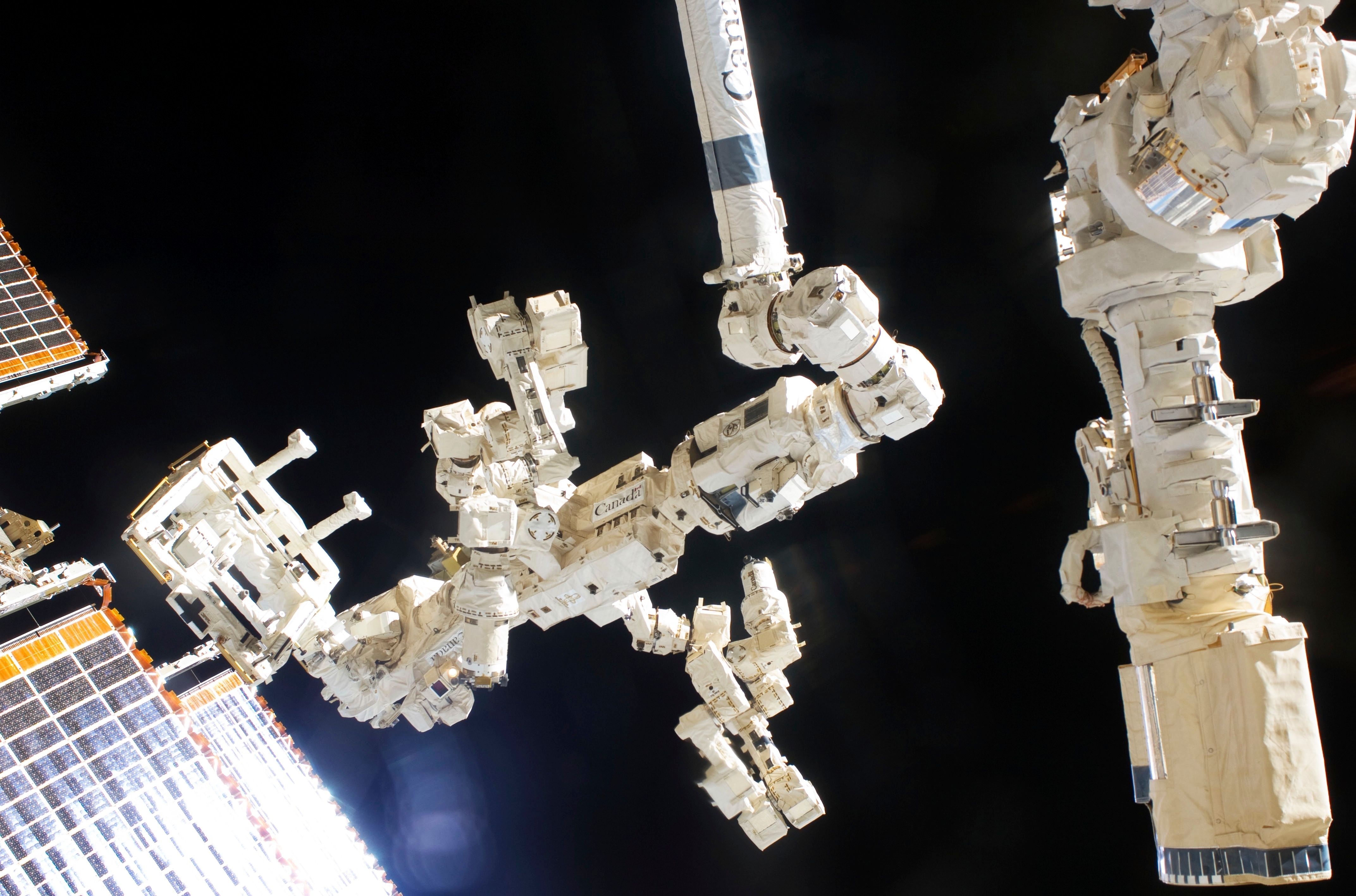
AI is poised to accelerate the industrialization of space. The nation that leads in AI might secure control of the space frontier before rivals realize it’s too late to catch up.
In an excerpt from his new book, Garrison Lovely argues that stopping the AGI race is entirely possible, but business interests stand in the way.